By Townhall News Editorial Board
Expanded in-person early voting opened across all 50 Chicago wards on Monday ahead of the Nov. 3 general election, and the Chicago Board of Elections began publishing daily vote totals the day before. Together, these steps represent something Chicago’s election apparatus has not always delivered: genuine transparency combined with broad voter access. The city deserves credit for both. Now it must sustain them through canvassing and certification to earn the public trust that elections in this city have historically struggled to command.
The logistics are significant. Suburban Cook County expanded from six early voting locations to 56, according to NBC Chicago, and Cook County Clerk Monica Gordon said her office has received more than 200,000 requests for mail-in ballots. The clerk’s office introduced an analytics platform called Election Lens, built with election technology firm KNOWiNK, to monitor polling activity in real time and track mail-in ballots from printing through return, Gordon said in remarks reported by CBS Chicago. Chicago election officials are expected to highlight accessibility and multilingual services at the new ward-level sites, ABC7 Chicago reported on Monday.
The decision to publish daily vote totals deserves particular attention. Knowing how many ballots have been cast early in person and by mail, broken down across the city, is exactly the kind of granular, real-time data that builds voter confidence. It allows campaigns, civic organizations and ordinary citizens to see the process unfolding in daylight rather than waiting for a single election-night data dump. In a city with Chicago’s well-documented history of electoral irregularities, that openness is not a luxury. It is a necessity.
Too often the national debate frames voter access and election integrity as opposing goals. Expand early voting, the argument goes, and you weaken safeguards. Tighten verification, and you suppress turnout. That framing is false, and Chicago’s current approach illustrates why. Publishing daily participation data does not slow down voting. Extending early voting to every ward does not prevent officials from tracking ballots with precision. Access and accountability reinforce each other when election administrators commit to both.
Illinois voter registrations are surging at more than four times the normal rate ahead of the online registration deadline, according to CBS Chicago. That enthusiasm is healthy for democracy regardless of which candidates benefit. But high turnout only strengthens democratic legitimacy when the public believes every valid ballot is counted and every invalid one is caught. “What’s good for the public is they have confidence where that mail ballot is going, all the way down to our carrier route and back to our office,” Cook County Deputy Clerk for Elections Ed Michalowski said, as reported by ABC7 Chicago. He is right, and that principle should extend beyond mail ballots to every phase of the process.
Some will argue that daily reporting creates opportunities for political operatives to game turnout strategies or that real-time data could be misused to spread misleading narratives about the vote count. Those concerns are not frivolous. But the alternative — less information, less visibility, less accountability — is worse. Sunlight has always been the best disinfectant for election administration, and the risks of transparency are far smaller than the risks of opacity in a city still working to live down its electoral reputation.
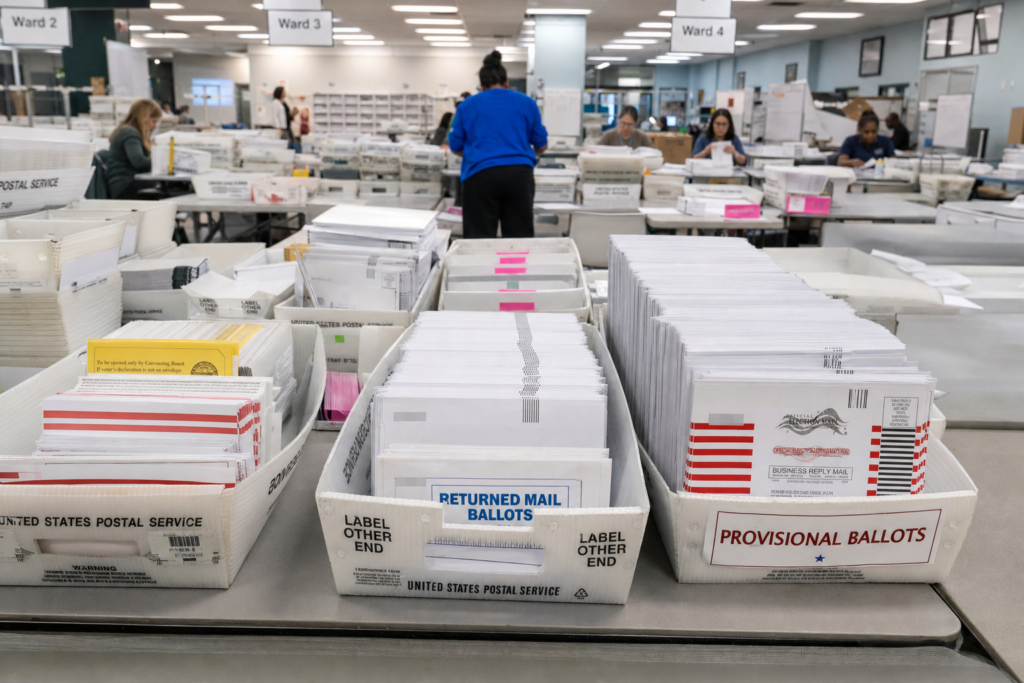
The real test comes after the polls close. Will the Chicago Board of Elections maintain the same openness during ballot canvassing, provisional ballot adjudication and final certification? Will the daily-total model carry forward into future election cycles, including municipal races that receive less public scrutiny? These questions matter more than the early voting logistics themselves.
Chicago voters deserve an election system that is both convenient and trustworthy. This week, the city took meaningful steps in that direction. The editorial board encourages election officials to treat daily vote-total reporting not as a one-cycle experiment but as a permanent standard and to extend comparable transparency to every phase of the count. Trust, once earned, is fragile. It requires consistency.
Sources: Chicago Board of Elections, Oct. 19, 2026 — Chicago Board of Elections, Oct. 18, 2026 — NBC Chicago, Oct. 18, 2026 — ABC7 Chicago, Oct. 19, 2026 — CBS Chicago, Oct. 18, 2026