
By Salem Chicago News Staff
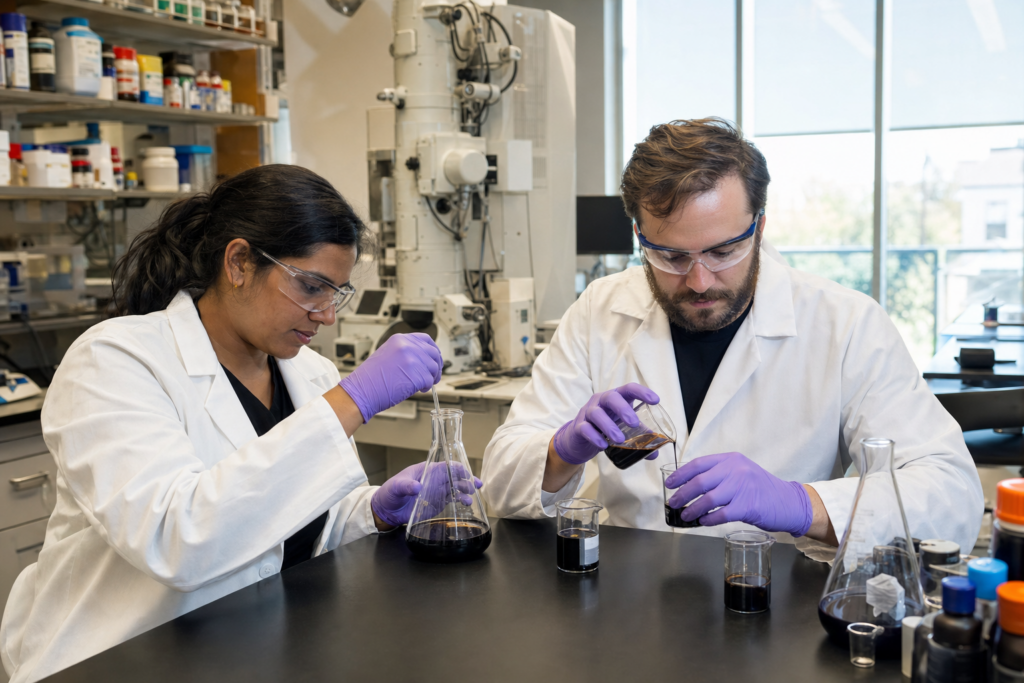
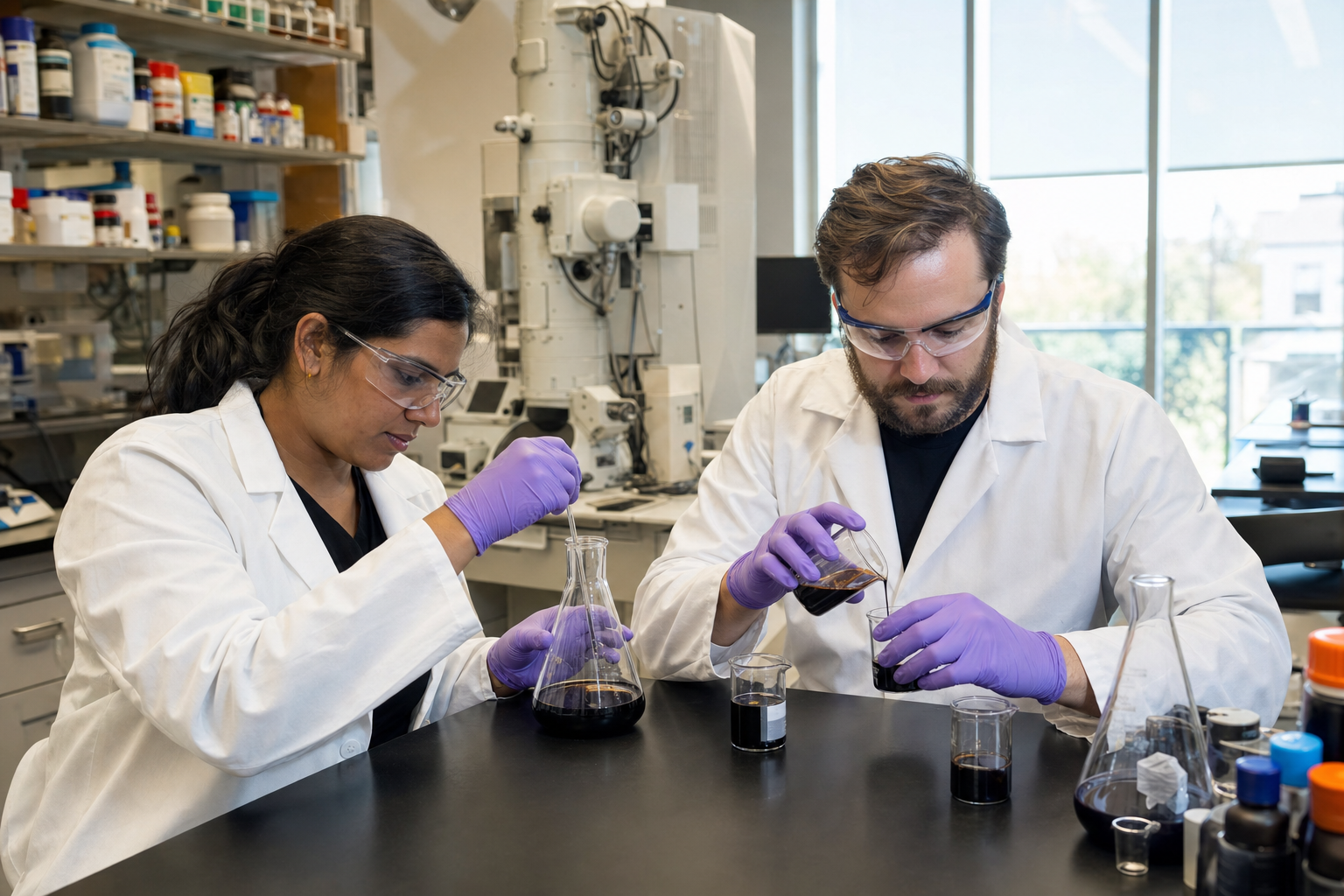
EVANSTON, Ill. — Northwestern University scientists have developed a nanoparticle-based compound that, when mixed into clothing dyes, could neutralize chemicals commonly found in nerve agents and pesticides.
The research, published in the journal ACS Nano, describes water-activated nanoparticles made from synthetic allomelanin, a renewable pigment found naturally in plants and fungi. The compound absorbs toxic organophosphorus chemicals and breaks them down, potentially offering protection to soldiers, agricultural workers and first responders.
“Our bioinspired melanins are non-toxic and can be used as an additive in clothing or facemasks and beyond,” Nathan Gianneschi, the Jacob & Rosaline Cohn Professor of Chemistry at Northwestern’s Weinberg College of Arts and Sciences, said. “You could imagine using this approach to make protective clothing, or breathing equipment for workers who make or use these materials to provide everyday protection.”
Gianneschi co-authored the study with Omar Farha, the Charles E. and Emma H. Morrison Professor of Chemistry and chair of the department at Weinberg.
To develop the nanoparticles, the researchers started with synthetic allomelanin, which contains a naturally porous structure of tiny cavities that can capture harmful chemicals. They then added zirconium clusters, metal compounds that catalyze chemical reactions. The allomelanin absorbed the toxic chemicals while the zirconium destroyed them.
The compound requires water activation to function. Researchers incorporated basic chemical groups onto the nanoparticles’ surface so that contact with water creates the alkaline conditions needed for the detoxification reaction.
In laboratory experiments, the toxic byproduct of organophosphorus compound breakdown decreased by 50 percent within 10 minutes. The process accelerated further with exposure to sunlight, because melanin naturally absorbs heat and reacts with solar energy.
“This intrinsic microporosity is required,” Sofia Aman, a graduate student in Gianneschi’s lab and the study’s co-first author, said. “When we tested other melanin-like materials, they didn’t work as well. So, we do need this porosity, and that just makes this allomelanin much more unique and a better substrate.”
Organophosphorus compounds are used legitimately as pesticides and insecticides but are also the basis of some of the world’s most dangerous nerve agents. The chemicals interfere with the nervous system by preventing enzymes from breaking down the neurotransmitter acetylcholine. When acetylcholine builds up, it prevents the brain from communicating with the rest of the body.
Manufacturers could potentially add the nanoparticles to masks, gloves, uniforms and tactical gear used by those most at risk. In an emergency, clothing could be sprayed with water mixed with the compound to deactivate a chemical before its effects take hold.
The research was supported by the Air Force Office of Scientific Research, the Army Synthetic Biology Centre for Predictive Materials Design and the Catalyst Design for Decarbonization Center. The work remains at the proof-of-concept stage, and further development is needed to establish long-term durability and manufacturing scalability.
Source: Northwestern University – For Journalists